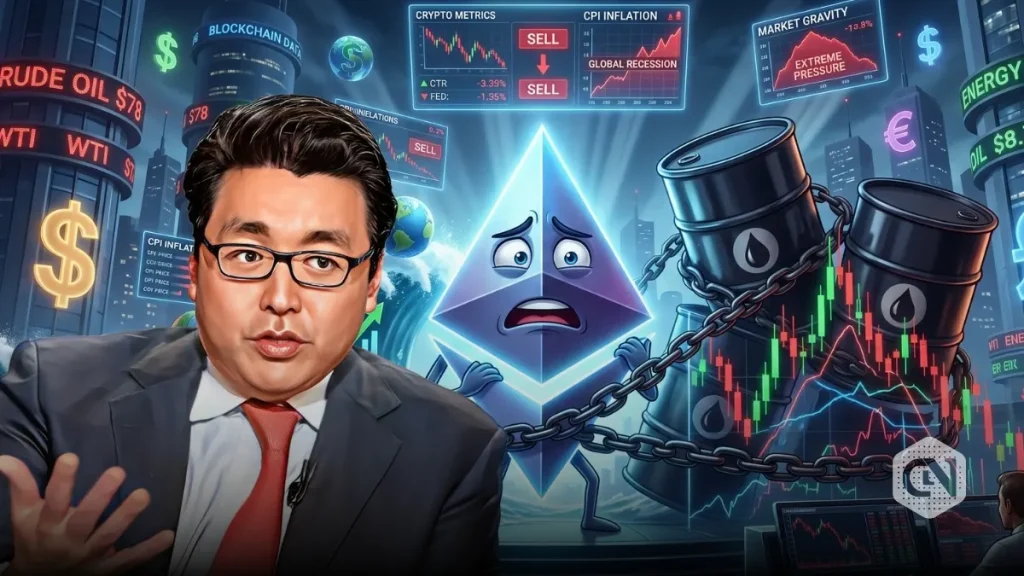
- Tom Lee in the X post suggests that rising oil prices may keep ETH down in the short term.
- Tokenization and AI wants, on the other hand, support Ethereum’s long-term vision.
- BitMine’s increase in ETH is increasing supply and renovating the market.
Tom Lee, the well-known crypto bull and founder of BitMiner Immersion Technologies, posted on X (formerly known as Twitter) earlier today, May 18, 2026, and said that there is a strange connection to explain the weakness of the price of Ethereum recently. According to this post, there is a negative correlation between Ethereum daily returns and West Texas Intermediate (WTI) crude oil prices.
Lee, with the help of various charts, showed that the daily return of Ethereum has reached a very low correlation of -0.4 with WTI, since oil has risen by about 23% in the past month amid international tensions. The founder of BitMine Immersion made it clear that rising oil prices have been a major problem for Ethereum in the short term, but long-term strong factors are expected to support ETH until 2026.
Lee framed the oil-Ether deal as a short-term market disruption rather than a real change in Ethereum’s fundamental strength. He also said that when oil prices rose six weeks ago, ETH declined, meaning that if oil returns, there is a possibility that Ethereum could recover. He also emphasized that the main drivers of Ethereum’s long-term growth have not changed, especially the increase of real world tokenization and the amount of demand from AI systems which can rely on smart platforms.
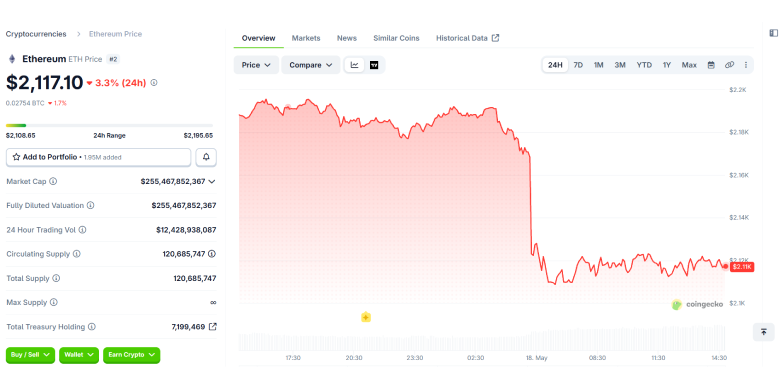
At press time, the price of The price of ETH-3.24% The token stands at $2,117.10 with a drop of 3.3% in the last 24-hours as per CoinGecko.
Why Oil Will Hurt Crypto in the Short Term?
Economists and market analysts point to a number of ways in which high oil prices can rush into risky assets, including crypto. First, higher oil prices often raise expectations of inflation, which can force real returns and create risks to financial and speculative assets.
Second, oil shocks can limit the growth of energy-exporting economies, reducing risk and reducing the amount of money available for beta exposure. Third, rising energy prices can increase uncertainty and volatility, encouraging rotation in seemingly safe stores of value or currency.
Crypto markets are very sensitive to extreme mood swings. Unlike other assets that have a clear financial history, many participants view ETH and other cryptos as speculative, so fear of inflation or aversion to risk can cause prices to fall. Lee’s latest connection shows, a negative reading of 0.4 on his pot, showing that in the measured window, the rise in oil coincides with the sale of ETH. The correlation depends on the screen and can move quickly, but the calculation itself shows a positive short-term relationship that needs to be evaluated.
Short Term Effects of Technology
For traders and risk managers, the important lesson is that short-term crypto strategies should contain larger portfolios such as oil prices and inflation in order to manage positions or hedge risk. If oil prices continue to rise, Ethereum may remain under pressure until market volatility eases or dynamic developments, such as major tokenization partnerships or rapid AI-driven adoption, help overcome that weakness.
Lee’s view is that this pressure is temporary, which is consistent with how successful investors often view the market consensus. In times of crisis, things work together, but those relationships often weaken when things settle down. If oil prices fall or fall, the pressure on ETH and other risk factors may disappear, allowing Ethereum’s long-term growth drivers to regain control.
Institutional ETH Accumulation Reshapes Market Dynamics
At the same time, at the beginning of this month, May 2026, the growth of corporate interest in Ethereum is adding another important factor to market activity.
Recent reports indicate that The Ethereum Foundation sold 10,000 ETH to BitMine Through an over-the-counter (OTC) contract as part of a financial plan to raise funds for support, research, and environmental development. The transaction was completed at an average price of approximately $2,292 per ETH.
Meanwhile, BitMine, led by Tom Lee, continues to build its Ethereum base and now claims to have 5.2 million ETH, or about 4.3% of the total amount. However, the company has delayed its acquisition and now hopes to achieve its 5% ownership goal by December rather than a year later.
Institutional buyers can limit the amount of ETH available on the open market, which can tighten supply and keep prices volatile. Oversupply can also change trading patterns, as some investors may buy in anticipation of continued demand for stocks.
At the same time, decentralized ownership also raises concerns about market influence and staking centralization, especially if a single entity controls a large portion of Ethereum’s supply.
What to Watch Next
Oil prices and inflation in the short term: If oil prices continue to rise and inflation remains high, Ethereum They may face difficulties in selling because investors often avoid risky products during periods of uncertainty. If oil prices fall, ETH can easily recover.
BitMine purchases require: If BitMine continues to buy ETH or manage to get a large private sale, less money will be available in the market and this is what will increase the value of the token. If the company slows down the purchase or sale of assets, the pressure may decrease.
The on-chain content shows the real: Wallet transactions, financial disclosures, dashboards, and major trading channels can help investors to know what the biggest ETH owners are doing instead of just relying on headlines.
Long-term contraception remains important: The growth of real-world assets, the use of blockchain, and the AI-driven demand for Ethereum smart contracts will likely boost the long-term value of ETH.
Final Thoughts
Tom Lee’s suggestion that Ethereum’s recent weakness is linked to its unusually negative correlation with oil suggests that economic shocks can temporarily shape crypto prices. Although this may be important for short-term trading, many experts still believe that the story of Ethereum’s long-term growth, driven by tokens and increasing demand related to AI, remains strong. At the same time, BitMine adds new concerns about liquidity, storage, and market appeal.
For investors, keeping a close eye on all the trends and information on the chain is important to determine whether the current pressure is a temporary instability or a major part of the market.
Also Read: Ethereum Underperforms Bitcoin as ETH/BTC Hits 10-Month Low