

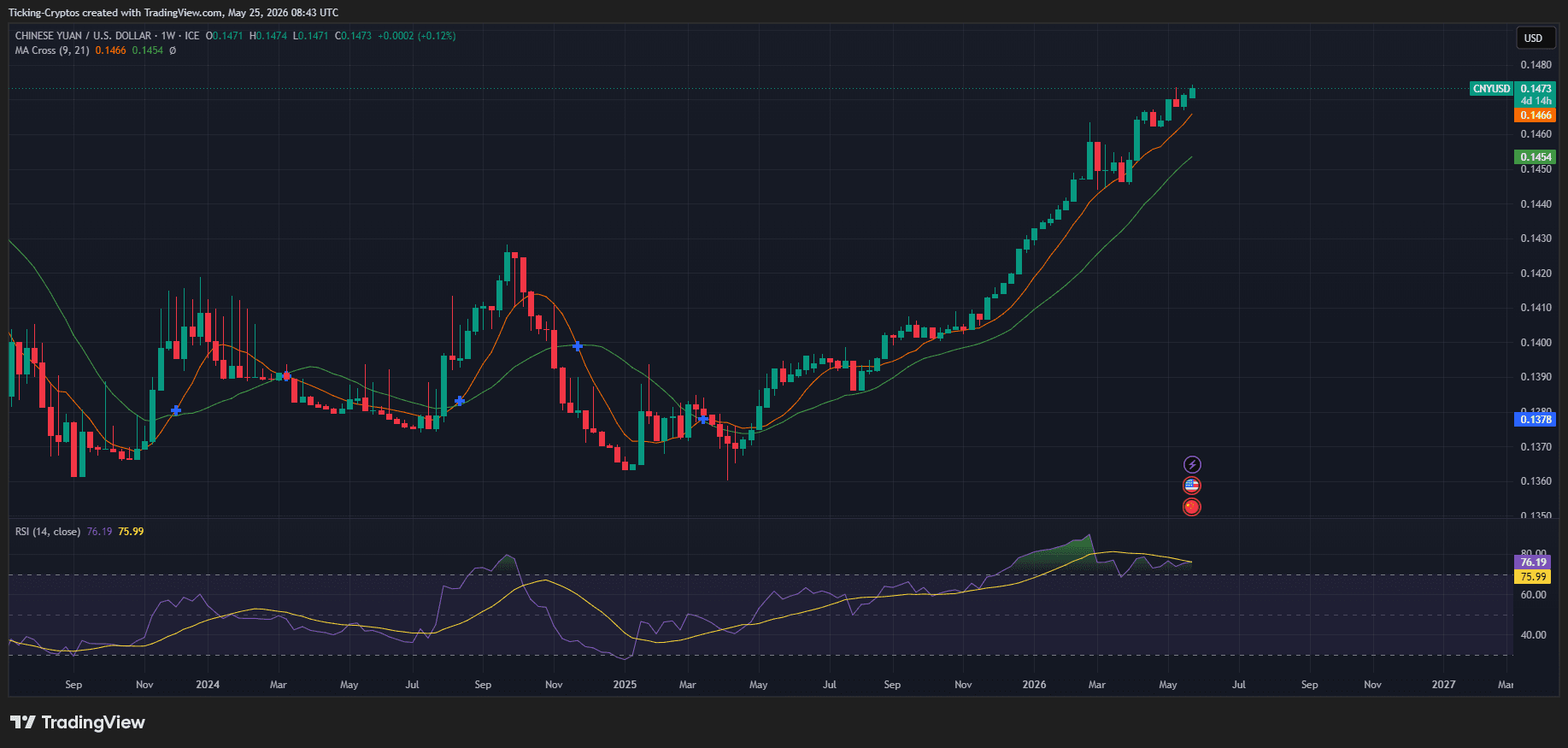
The Chinese Yuan (CNY/USD) It has risen to a three-year high against the US dollar, rising steadily to the 0.1473 level. The decline in the currency is due to a wide range of political tensions and major changes in global energy trade, in particular, it is said that Iran has helped to repatriate oil exports by using the Chinese currency to bypass Western currencies.
As the chokepoint of the Strait of Hormuz is facing the biggest disruption in energy history due to the ongoing conflicts in the region, the long-term visibility of “petroyuan” it is rapidly changing from a speculative perspective to a stable market, leaving clear signs on the forex charts.
Is the Petrodollar Dead?
The traditional petrodollar system is facing its biggest crisis in six decades, but it is not collapsing overnight. The displacement of the dollar in Iran’s stable power centers represents the erosion of Greenback hegemony rather than the elimination of the global currency.
Although the US dollar is still the dominant currency in international markets and financial markets, trade networks operating outside of the SWIFT system are expanding. Investors will be watching closely to see how this decentralization will change the world’s financial system – and whether it will ultimately contribute to the digital economy.
Petrodollar Analysis: The Yuan’s Bullish Run Against the Dollar
A close look at the CNY/USD weekly chart shows the undeniable strength of the Renminbi over the past year. Following the bottom around the end of 2024 near 0.1365, CNY/USD entered a strong, familiar uptrend.
CNY/USD Weekly Technical Analysis for CNY:
- Current Price: 0.1473 (3-year High)
- Moving Average (MA) Cross: 9-period MA (0.1466) leading strongly above 21-period MA (0.1454)
- RSI (14): Sitting at 76.19 (Overbought Territory, indicating a big buy)
The 9-week moving average has been a strong supporter of both rallies, confirming that China’s currency is improving. However, with the Relative Strength Index (RSI) pushing deep into the overbought zone at 76.19, this multi-year consolidation phase is very likely before the next leg.
Understanding the Petrodollar versus the Petroyuan
To understand the size of this market, it helps to understand the basic mechanics:
- Petrodollar System: Established in the 1970s, the system stipulates that global commodities – particularly crude oil – are priced and fixed in US dollars ($USD$). This forces foreign countries to maintain large dollar reserves, strengthening the greenback’s position as a global currency.
- Petroyuan: This means the settlement of oil and gas using Chinese Renminbi ($RMB$ or $CNY$). By setting oil prices in yuan, energy exporters can trade directly with the world’s largest refiners while avoiding US bank rails and exposure to potential sanctions.
US-Iran War: Iran Receives Yuan
In light of reports of a recession that continues in the conflict, the volume of crude oil trading in yuan has soared. The China Cross-Border Interbank Payment System (CIPS) recently set a record for one-day transactions, showing the number of cross-border transactions outside of dollar transactions.
Even famous organizations like Federal Reserve show that the dollar still dominates the volume of international FX transactions, experts agree that the “golden window” for the use of the renminbi in the world is opening. The rise of energy and financial instruments is causing emerging markets to shift their savings.
How Will This Affect The Crypto Market?
When fiat money is decentralized, other financial networks attract investment. The rise of the multi-currency electronic market can affect cryptocurrencies—especially Bitcoin ($BTC)– in several different ways.
1. Accelerating the Definition of Bitcoin Ruler
If nations can no longer rely on a single, secure global currency to protect their purchasing power or guarantee trade, a decentralized, neutral economy becomes more attractive. Bitcoin works outside of Washington and Beijing. The weakness of the petrodollar infrastructure reinforces the view that Bitcoin is immutable, cross-border.
2. Increased Liquidity in Offshore Crypto Corridors
Interestingly, reports indicate that some forwarding agencies and independent traders have begun to use a combination of yuan and international crypto to facilitate trade. As a subset of FX flows, the growing digital asset space acts as a financial bridge for cross-border transactions.
3. A Macro Hedge Against Fiat Inflation
The ongoing energy crisis has forced central banks around the world to reconsider their timing of monetary easing. If a fragmented oil market leads to persistent inflation, traditional fiat money will continue to lose its purchasing power. Investors to follow The price of Bitcoin The index often sees the digital economy as a rare game, similar to digital gold, able to outlast global inflation.
Summary of Economic Indicators
The table below shows the changes observed in the global markets during the currency revolution:
| Metrics / Assets | Market Updates | Underlying Macro Driver |
|---|---|---|
| CNY/USD exchange rate | 3-year low at 0.1473 | Increasing trade volume & economic growth in China. |
| US Dollar (DXY) | Dealing with the same technical resistance | Lack of transparency in bilateral energy contracts. |
| RSI Momentum (CNY/USD) | An increase of 76.19 | Parabolic demand for Renminbi liquidity on western fiat options. |
| Bitcoin (BTC) | Acting as a non-correlated macro hedge | The important development of neutral, censorship-free stores. |



