


Author
Ahmed Barakat
Author

Share it

Solana breaking news: Moody’s Ratings placed its credit database on the Solana mainnet on June 17, 2026, through a partnership with AlphaLedger, making Solana the first public, permissionless blockchain to carry Moody’s credit ratings live in a machine-readable format.
The integration embeds ratings directly into the metadata of tokenized bonds and other fixed assets, meaning that the credit token moves with the asset on the chain rather than behind a storefront.
For participants who build on Solana’s RWA stack, this closes a very common gap in credit markets: access to standardized, independent credit analysis at the protocol level.
Contrasting with Moody’s earlier release of the Canton Network is structurally required. Canton is a permissioned, decentralized blockchain with a defined community of participants.
In line with Solana’s open framework, any wallet, exchange, or DeFi protocol can now query Moody’s credit directly from the token’s metadata without verifying through a closed network. This shift from licensed to unlicensed is what makes this announcement so different from what Moody’s has done in the past.
Note: The best crypto to change your profile
Solana News: How the Signal Integration Engine Works on Solana
Moody’s Token Integration Engine, known as TIE, is designed to be the foundation of the network: tokens are issued from the chain using Moody’s standard method, and then pushed onto the chain via an API.
AlphaLedger page, where they are entered into the metadata of the default security token. When the rate changes, up or down, the changes are automatically propagated across the chain, so any app that uses the data gets a credit signal rather than a fixed snapshot.
The system was first confirmed in the June 2025 proof of concept on Solana’s devnet, where AlphaLedger took the issuance of a municipal bond, Moody’s did a credit analysis, and the results were recorded in the token’s metadata and queried with smart contracts.
The mainnet release shows a proof of concept in the making, with an initial focus on US municipal bonds and other fixed assets.
Manish Dutta, Chief Executive Officer of AlphaLedger, said the merger will allow automated markets to use the credit information that investors rely on in traditional fixed-income markets. The design is correct: the goal is not to create a standardized method of reading but to make the existing one systematically available to the public.
Rajeev Bamra, Head of Digital Economy Strategy at Moody’s Ratings, said investors need access to independent credit in social media.
TIE’s unique challenge is to manage risk automatically, providing DeFi protocols and digital platforms with reliable, machine-readable credit that they can use to make collateral decisions, limit policies, and investment filters without having to follow proprietary feeds.
This use has been speculative in bond markets until now.
The Location of Solana’s Institutional RWA: What This Integration Proves
Moody’s merger comes as Solana’s financial pipeline has grown significantly. Western Union launched a stablecoin for the US dollar on the network in a bid to send low-cost transactions.
Blockchain development R3, whose Corda network counts HSBC, Bank of America, Bank of Italy, and the Financial Authority of Singapore as students, partnered with the Solana Foundation to port tokenized assets to Corda on Solana.
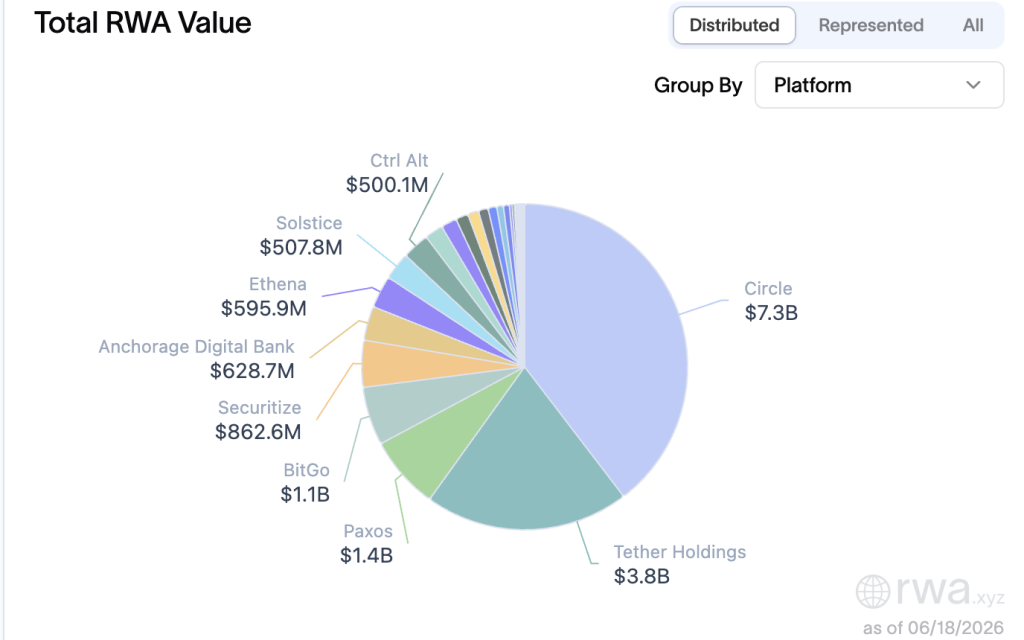
Asset managers including BlackRock, Franklin Templeton, and Apollo have already launched token sales across the RWA region. Boston Consulting Group and Ripple estimate that the market value could reach $18.9 trillion by 2033.
Nick Ducoff, Director of Institutional Growth at the Solana Foundation, said Moody’s merger will increase the transparency and availability of tokenized assets online.
What’s widely read is that putting the Big Three’s checks into securities removes a major objection to static desks that check products from Solana: the lack of consistent, independently verified data.
Investors in institutional fixed income are not subject to price risk without Moody’s, S&P, or Fitch, having an in-demand stake in the public sector is essential to being highly regarded, not just jewelry.
Moody’s has indicated that TIE will expand beyond municipal infrastructure to corporate, autonomous, and financial instruments as tokenization grows, and will extend to additional blockchains beyond Canton and Solana.
The multi-brand structure is deliberate, with Moody’s positioning TIE as the basis for rating the broader credit market, not as Solana’s sole product.
Solana is becoming more and more popular with the industry points out that the network is setting a standard guideline for RWA releases to the public, but Moody’s deployment itself is speculative by design.
Whether these leading-edge platforms converge or compete depends on how quickly providers and protocols integrate TIE data into live products, and how much total revenue they generate to achieve it.
The price of SOL shares it has been following what is happening in the market more than protocol issues, which is in line with where the establishment of institutions is at the moment: real progress in infrastructure, which has not been seen in recent prices.



