


Author
Ahmed Barakat
Author

Share it

Senator Bill Hagerty told FOX Business on June 18 that he still hopes the Digital Asset Market Clarity Act can clear the Senate before the July 4 recess, even though he acknowledged the bill could extend beyond Independence Day.
His hope is falling on the wall of reality: the CLARITY Act has not received the votes of the Senate, it still needs to clear 60 votes, and it requires reconciliation between the two texts of the Senate committee before any agreement of the Senate.
The difference between Hagerty’s expectations and the legislative calendar is measurable. Congress has less than 9 business days before July 4th.
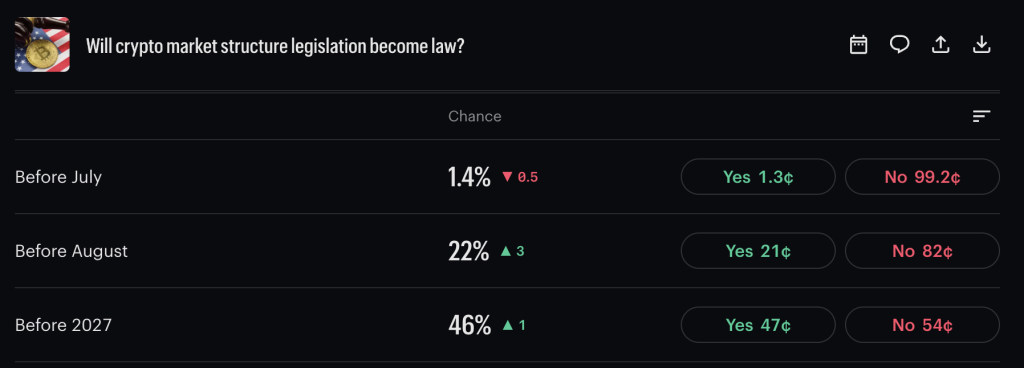
Kalshi’s prediction markets are currently selling the passage of the Senate by August 2026 at about 22%, which shows the main estimator that: this passage this summer is possible, the passage before July 4 is a completely different question.
The House passed the resolution on July 17, 2025, by a margin of 294-134, a bipartisan result that made the law permanent.
The Senate Banking Committee followed through and approved it 15-9 on May 14, 2026, advancing the bill to the Senate legislative calendar. This made the ground work possible. It didn’t make it close.
At its core, the crypto rules would establish a CFTC-led system for digital assets — putting assets like Bitcoin and Ethereum under CFTC oversight while giving the SEC less power over other trading and exchanges.
The separation of powers is the main source of the bill’s plan, and it has real market implications: Standard Chartered said that this clause could open up $8 billion in XRP ETF entries alone, depending on the validity of the plan to be issued.
Three Obstacles Between the Clarity ACT Bill and a Senate Vote
A total of 60 votes the first part is the first part. The Senate Banking Committee’s 15-9 approval shows committee support, but changing the 60-vote floor requires a bipartisan buyout that hasn’t been publicly secured.
That risk doesn’t move regardless of how lawmakers and industry agree on the bill.
The second obstacle is coordination between committees. The text of the Senate Banking Committee and other texts of the Senate Agriculture Committee should be combined into one bill ready for the floor.
The two committees share power over the CFTC-SEC split between the rules, and each manager’s amendment to resolve their conflict must be submitted before a vote is scheduled. That part alone takes several weeks of staff discussion.
The third obstacle, and the most active one, is the cultural debate. David Nage, general manager and portfolio manager at Arca, said after the meetings with the Senate offices that lawmakers and industry partners are about 80-85% in agreement on the contents of the bill, and that the stablecoin will provide yield, despite the continued opposition of JPMorgan CEO Jamie Dimon, is no longer a serious problem.
What’s left is a fight with interest on how to prevent government officials from engaging in crypto-related business while in office.
Senator Kirsten Gillibrand is said to have urged support for clear language barring officials from profiting from cryptocurrencies, warning of illegal votes without the clause.
That is not a small matter of writing, it is a senator who has more than 60 mathematical advantages that make the real demand. Nage characterized the existing disagreement as a question of politics and implementation, not a dispute about the market, but political questions are what hinders the schedule.
Unions of sports organizations, national governments, and labor unions are different pushed the Legislature to include language prohibiting betting markets from awarding gaming contracts to casinos under the CLARITY Act framework, another controversial section that increases reconciliation before all floor votes are met.