


Author
Ahmed Balaha
Author

Share it


The European Central Bank (ECB) has officially backed a proposal to transfer oversight of crypto-asset providers to the European Securities and Markets Authority – a move that would collapse the country’s 27 fragmented licensing authorities into a single Paris-based framework.
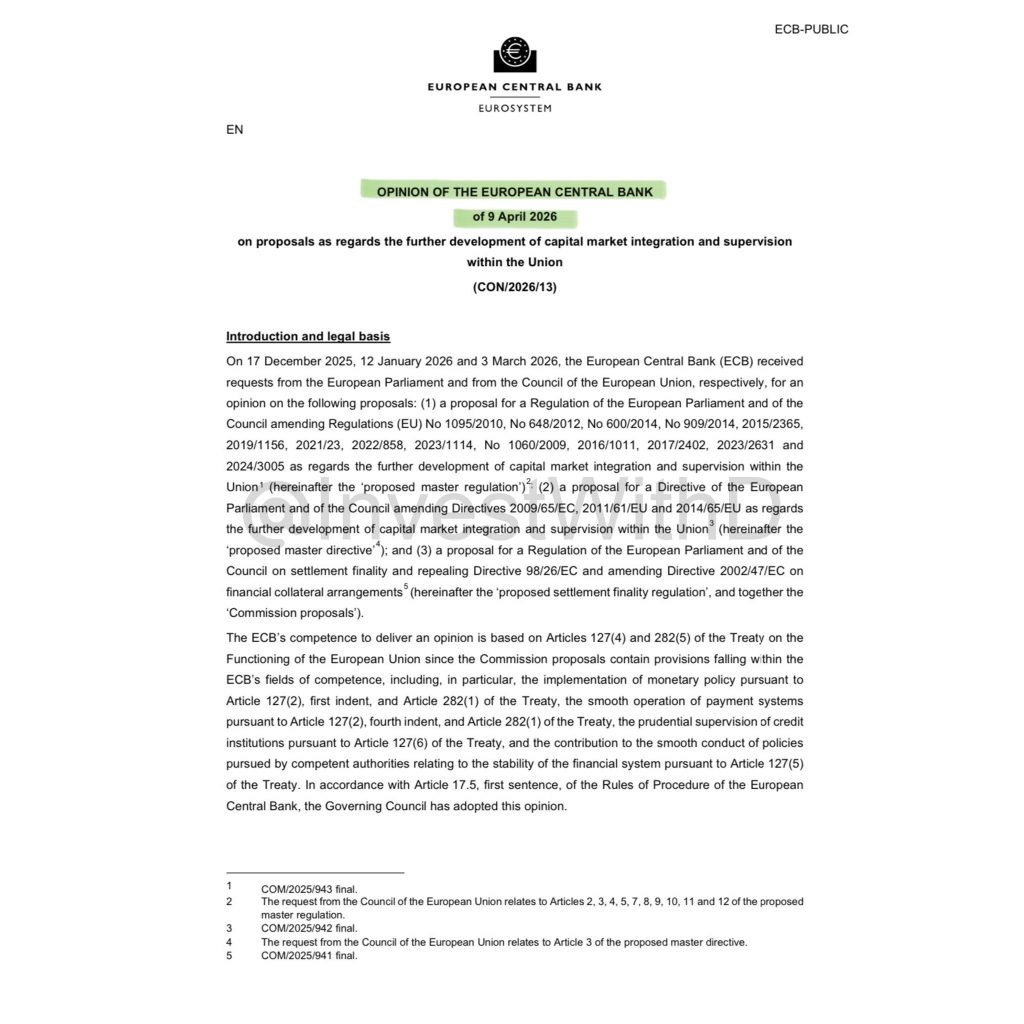
The ECB’s decision, issued in response to the European Commission’s capital markets package for 2025 (COM/2025/941, 942, 943), places ESMA as the direct supervisor of crypto-asset service providers across the EU.
The push is already sparking criticism from member states that have built their regulatory systems – and licensing fees – around the MiCA model of governance.
Ireland, Luxembourg, and Malta have emerged as the preferred jurisdictions to issue crypto licenses under the current system. Centralized supervision by ESMA could destroy competitive advantage overnight.
The question is not whether the ECB wants this. It clearly does. The question is whether the Commission’s capital markets investment can survive the member’s long-standing resistance to enacting legislation.
- The role of the ECB: The ECB supports the transfer of CASP supervision from the authorities to ESMA in line with the Commission’s 2025 capital markets strategy.
- MICA Impact: ESMA’s centralized supervision would replace 27 national enforcement authorities with a single authority, eliminating inconsistencies in licensing across EU countries.
- ECB Institutional Inquiry: The ECB is asking for non-voting membership on ESMA’s new Executive Board for CASP-related discussions, including access to data and risk-related funding requirements for the crypto industry.
- Stablecoin Exposure: The ECB is pushing indicators on e-money tokens used as stable assets in the absence of central bank money – a direct obstacle to euro-pegged stablecoin scale.
- Time: MiCA’s flexible terms expire in Q1 2026; ESMA’s additional funding, if approved, could be entered into alongside the EBA’s substantive review which takes place at the same time.
- Licensing Hub Risk: Member states with established crypto licenses face losing regulatory powers and diversifying competition if ESMA centralization passes.
- Watch: The Commission’s discussions on capital markets 2025 – any approval of ESMA’s direct control shows that central pressure is decreasing politically.
Find out: Top Crypto Deals to Watch This Month
How Does ECB ESMA-Led Supervision Change Exchanges and Crypto Stablecoin Issuers Operating Across the EU?
Under the MiCA architecture, crypto-asset service providers receive a license from their member state’s international authority – and then an EU-approved license. This example shows how financial firms operate under MiFID II.
On paper, it offers a one-stop shop. On the contrary, it improves compliance: a CASP licensed in an NCA-controlled area faces different pressures than one licensed in a stricter regime, even though both have the right to issue passports to the EU.
Direct supervision under the supervision of ESMA eliminates this difference. Exchanges above the scope of this provision may report to ESMA instead of their home NCA – meaning that the regulatory standards, monitoring frequency, and penalties remain the same regardless of where the company chooses to incorporate.
ESMA already maintains a public register of ART and EMT providers and has the authority to use a crypto blacklist for non-compliant CASPs. Direct oversight powers for large CASPs extend from registry preparation to enforcement. It’s a very different job than organizations.
For stablecoin providers in particular, the ECB’s push for tokens on e-money as a stable asset — absent central bank money — adds a second set of hurdles. Important EMT providers have already introduced EBA supervision on €5 billion in storage facilities or 10 million users.
A fixed cap set by the ECB would set a strong upper limit on those levels, regardless of the EBA’s demand. Major exchanges that operate major stablecoins – including Binance and OKX, whose disclosures have sparked market scrutiny. – face that risk if it reaches the final implementation.
Note: The best crypto to change your profile
Why Is The ECB Pushing This Now – And What Does Its Inquiry Reveal?
The ECB’s decision did not happen automatically. The European Commission released three legislative proposals at the end of 2025 – COM/2025/941, 942, and 943 – designed to expand the Capital Markets Union by expanding ESMA’s direct powers over CCPs, CSDs, CASPs, and trading venues.
The ECB’s official response to this package is where ESMA’s support arrived, along with a special request from the institution: non-voting membership on the new Executive Board of ESMA in discussions about crypto-asset service providers.

That request is important. Membership of the non-voting board gives the ECB a representative seat in ESMA’s supervisory deliberations without the need to extend the ECB’s authority.
It is a monetary policy approach to managing crypto supervision without legal intervention – and it shows that the ECB sees the role of CASP as related to financial stability, not the integrity of the financial market.
The ECB also announced a more transparent staffing, warning that ESMA needs “sufficient work and money” to take on additional supervisory responsibilities without stress.
That is not a platitude. ESMA’s statement in January 2025 pushing the NCAs to impose restrictions on non-compliant MiCA-ART and EMT providers by the end of Q1 2025 has already tested the ability of the authorities.
Increasing direct monitoring of CASP without increasing population size would also stress the same infrastructure. These guidelines reflect what is happening elsewhere – Japan’s crypto reclassification under the Financial Instruments and Exchange Act it also shows a global trend: big authorities are moving crypto from a payment neighborhood to a security-type supervision with direct supervisory teeth.
Note: The best deals before the sale starts



