

- EMURGO, the co-founder of Cardano, has partnered with Slash Vision Labs to bring the Cardano Card to Japanese consumers through SecondFi, its self-service platform.
- The Cardano card will allow users in Japan to pay cryptocurrencies through a QR code payment system for their daily needs.
- The formation of a bearish flag drives a short-term consolidation in the price of Cardano before the end.
On Monday, May 18th, the price of Cardano showed a small loss of 0.1% trading at $0,252. While the broader crypto market experienced a selloff due to Bitcoin’s attempt to break from $77,000, the ADA price is showing resilience above $0.25. Lower buying pressure may be due to recent announcements a partnership between SecondFi and Slash which is planning to integrate the Cardano card into payment terminals in Japan.
Cardano Enters Japanese Payments Market Through EMURGO-Slash Deal
EMURGO, the trading arm of Cardano announced a strategic partnership with the investment technology firm Slash Vision Labs of Japan, with the aim of bringing the native cryptocurrency into the hands of regular Japanese consumers.
The deal will focus on a product known as the Cardano Card and will be managed by Japanese software developer Slash Vision Labs. Slash’s stablecoin payment infrastructure, created by Japanese financial regulations and the reality of domestic payment systems, is completely different in Japan from the tap-and-go card culture common in Western countries.
The company’s involvement is through its self-sustaining SecondFi platform, which functions more like a neobank than a traditional crypto wallet. Users can access the financial instruments available in traditional banks but do not give third parties control over their assets. Cardano Card bridges the real estate and real estate transactions, so that users can spend money without having to convert it through a different exchange or interface.
Japanese Law and Market Context
Japan has a special place in Cardano’s trading history. The network’s token, ADA, has gained a lot of trading capital in Japan during the early stages of the crypto craze, and the market share has not seen a significant decline compared to other markets. Unlike many similar economies, Japan has also resolved many issues related to the distribution of cryptocurrencies and the authorization of exchanges, creating an excellent environment for companies such as. EMRUGO creating well-managed financial products. The Financial Services Agency has taken a regulatory approach to cryptocurrencies for nearly a decade, making it more predictable than other markets in the region, according to cryptocurrency companies.
Slash Vision Labs has been moving forward to integrate into the Japanese market with its stablecoin card, called the Slash Card. This infrastructure is extended to SecondFi users with the Cardano Card partnership. The logistics, local financing methods and Japanese financial requirements for consumer goods are all being handled in Slash’s ways, not new to the EMURGO relationship.
Since Cardano’s journey in Japan, we’ve been wishing that Japanese ADA holders would be able to do more than just touch and insert. Partnering with Slash, Japan’s leading crypto-native provider, is a natural way for us to expand our commitment to this emerging market. Following the successful launch of Cardano Card and the launch of SecondFi, growing the Japanese blockchain community was the next obvious step. said Phillip Pon, CEO of EMURGO
Connecting Crypto with Everyday Use
A global trend for Japanese users would be the ability to use their crypto assets (via stablecoin protocols) in stores that accept the QR code payment methods used by Japanese people. Cashless payment systems in Japan are a mix of competing systems, all of which have been integrated into consumer behavior and lifestyle when paying for food, transportation, and everyday purchases. Having a crypto-backed card connected to the network is one of the sticking points that has made it difficult to make cryptoholdings more useful than real estate.
Stablecoins have the potential to become a part of everyday payments, but delivering what has happened in Japan requires an infrastructure designed for the local market. We’re excited to partner with EMURGO and SecondFi to help bring real world content to users across Japan. ” said Shinsuke Sato, CEO of Slash Vision Labs
The Cardano card has not yet been launched for Japanese users. There is a waiting list available on SecondFi’s website at secondfi.io, with the company saying that cardholders will be notified before they are issued. Announcements do not specify a launch date.
What This Means for Cardano and ADA
This partnership contributes to the Cardano ecosystem in several indirect, but disruptive ways. Users in Japan who use QR codes create automatic tracking of small items, which leads to a real-time system that managers are starting to consider in addition to the price.
Stablecoin flows – specifically USDCX, Cardano’s stable USDC – are locked in native wallets rather than on external chains, gradually increasing the value of the closed network. Every transaction on the stablecoin runs and ends on the Cardano network, which continues to pay online payments in ADA, all without the need for consumers to buy the token directly.
More importantly, breaking the heavily regulated Web3 format in Japan gives Cardano a stamp of approval that fits the global business conversation. A successful launch in Japan is seen as a major market test.
Price convergence tends to be subtle, gradually increasing and creating a support base under speculative valuations over time.
Cardano Price Faces Major Damage Test on Bear Flag Pattern
In the last week, a The value of Cardano showed a change in the V-top from $0.288 to $0.252, registering a loss of 12.8%. An analysis of the daily chart shows this pullback as a bearish cycle within a reversal pennant formation.
The chart setup is characterized by a large price drop, followed by a lower consolidation within the two trend lines. This short period of time allows traders to regain their momentum and drive further losses.
If the model is true, Cardano ADA-1.92% the price may drop another 2.85% and break the downtrend to accelerate the sell-off. A subsequent fall could push the price below $0.228.
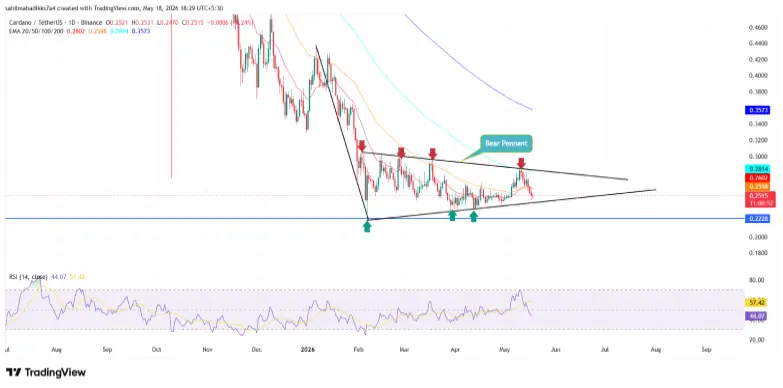
However, the price drop will determine the actual implementation of the model. If the currency price breaks above the current trend, buyers will also gain strength in the short-term trend.



