

- On Wednesday, the Fidelity Digital Assets chapter took a closer look at the USD-pegged stablecoin, FIDD, which is built on Ethereum.
- Amid the growth of the stablecoin market, Fidelity will integrate FIDD into existing financial products for both retail and institutional investors.
- To counter the strength of USD stablecoins, a group of 37 European banks are coming together to launch a Euro-pegged stablecoin in the second half of 2026.
On May 20, Fidelity Digital Assets’ Head of Product Strategy, Terrence Dempsey, took a closer look at his dollar-backed stablecoin called Fidelity Digital Dollar (FIDD) amid the steady growth of the stablecoin market.
What is FIDD?
According to official announcementFIDD is a dollar-pegged stablecoin that maintains its peg with the dollar. This stablecoin will be issued by Fidelity Digital Assets and the National Association, which is a federally chartered national trust bank. Users will be able to purchase FIDD tokens directly on Fidelity platforms.
FIDD will be backed by cash, US Treasuries, and other safe, liquid assets. In order to ensure the safety of this stablecoin provided by Fidelity, the stablecoin reserves will be managed by Fidelity Management & Research Company LLC, which will be held at the Bank of New York Mellon.
The announcement said a stablecoin will be available on Ethereum and users will be able to transfer to “the proper addresses of the Ethereum mainnet.” This will open the door to the “big types of use on the chain.” It means that users can easily transfer these tokens to official programs, wallets, and cryptocurrency exchanges.
This stablecoin is designed for both retail and institutional investors, and can be purchased through Fidelity platforms, including Fidelity Crypto. This digital dollar has been listed on other exchanges, such as Bullish and Kraken, and in the near future, it is expected to be available on other exchanges.
How FIDD Differs from Other USD-Pegged Stablecoins
Although FIDD has similar features to well-known stablecoins such as USDT and USDC, the company said that the stablecoin is different from others based on “how it is built and used.”
The official announcement said, “Fidelity Digital Assets manages FIDD through an integrated, end-to-end model – issuance, database management, storage, sales, marketing, and ongoing management under one operational and governance structure.”
“By creating and maintaining a complete asset in-house, Fidelity Digital Assets can use the same standards for technology, controls, and risk management, reducing reliance on third-party vendors and helping to better demonstrate the stablecoin’s performance throughout its lifecycle,” it added.
Fidelity is using a model that helps reduce reliance on third-party vendors. Instead of just providing the token, Fidelity will integrate this new tool with the existing infrastructure. Existing Fidelity customers for a variety of services such as brokerage, retirement, and wealth management will have access to FIDD.
The official announcement also stated how the company would protect consumers, saying that “This final design supports a robust risk management system designed to protect customer information and help protect assets. Fidelity Digital Assets solutions are built with a security-first mindset and are continuously updated to meet strong operational goals – principles that extend to the design and management of FIDD.”
Stablecoin Market Sees Amazing Growth Due to Systematic Clarity
Amid the growing clarity and acceptance of digital assets in traditional economies, the stablecoin market is moving forward. According to Try itThe current stablecoins market capitalization is approximately $323.112 billion, with a major dominance of USD-pegged stablecoins such as USDT and USDC.
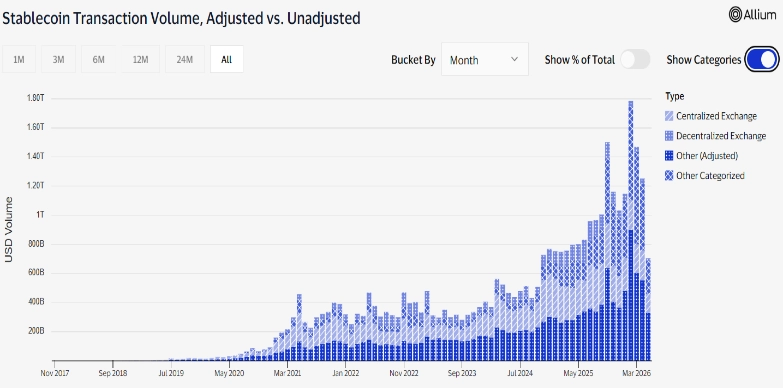
(From: Visa on-chain analytics)
According to Visa’s on-chain dashboard, over the past 12 months, total transaction volume has reached $78.8 trillion.
Of all stablecoins, USD-pegged stablecoins account for over 99% of the total market value. Major financial platforms and organizations such as JPMorgan have integrated stablecoins into their existing financial services due to its practical application. By combining these features, they can streamline cross-border payments while simultaneously reducing costs.
According to Citigroup bank reportthe stablecoin market is expected to reach $1.9 trillion in startups and $4 trillion in bull cases by 2030.
Last year, US President Donald Trump signed the Guideline and Implementation of National Innovation in the United States Stablecoins (GENIUS) Execute the command. This has created the first federal framework for stablecoins. According to the law, stablecoin issuers are required to ensure that stablecoins are properly supported by holding good reserves such as cash and treasury stocks.
Apart from this, the GENIUS Act also requires stablecoin issuers to maintain transparency by providing full information and regular audits.
Last week, a The Senate Banking Committee has moved forward CLARITY Act in a 15-9 vote. The vote came during an informational session where lawmakers debated potential delays and made some changes to the final draft.
After a long discussion, the banking industry and the crypto industry came together and agreed on the issue of productivity. After this compromise, stablecoin issuers will be able to offer a yield based on activity. However, they will not be able to provide a sustainable harvest.
Europe’s Qivalis Rises Against USD-Backed Stablecoin Authority
Although USD-pegged stablecoins still dominate the digital economy, Europe is planning to curb this dominance.
Qivalis, a joint venture based in Amsterdam, recently received support from 37 major banks in Europe, including BNP Paribas, ING, CaixaBank, UniCredit, and others. These banking groups hold trillions of dollars in customer deposits. Qivalis is now planning to launch a euro-pegged stablecoin that will comply with the European Union MiCA regulations. Qivalis plans to issue a euro-pegged stablecoin in the second half of 2026, and it will be supervised by the Dutch Central Bank.
Qivalis plans to reduce Europe’s reliance on USD stablecoins after Christine Lagarde, the President of the European Central Bank (ECB), issued a warning in this regard. He said in Press release that, “Europe must respond by strengthening its euro-denominated stablecoins. Otherwise, it faces a future of digital dollarization and loss of monetary authority.”
According to him, the dominance of the dollar stablecoin in token markets in Europe is a “legitimate concern.”
Also Read: Vitalik Buterin Reveals Short-Term Plan to Increase Ethereum Privacy