

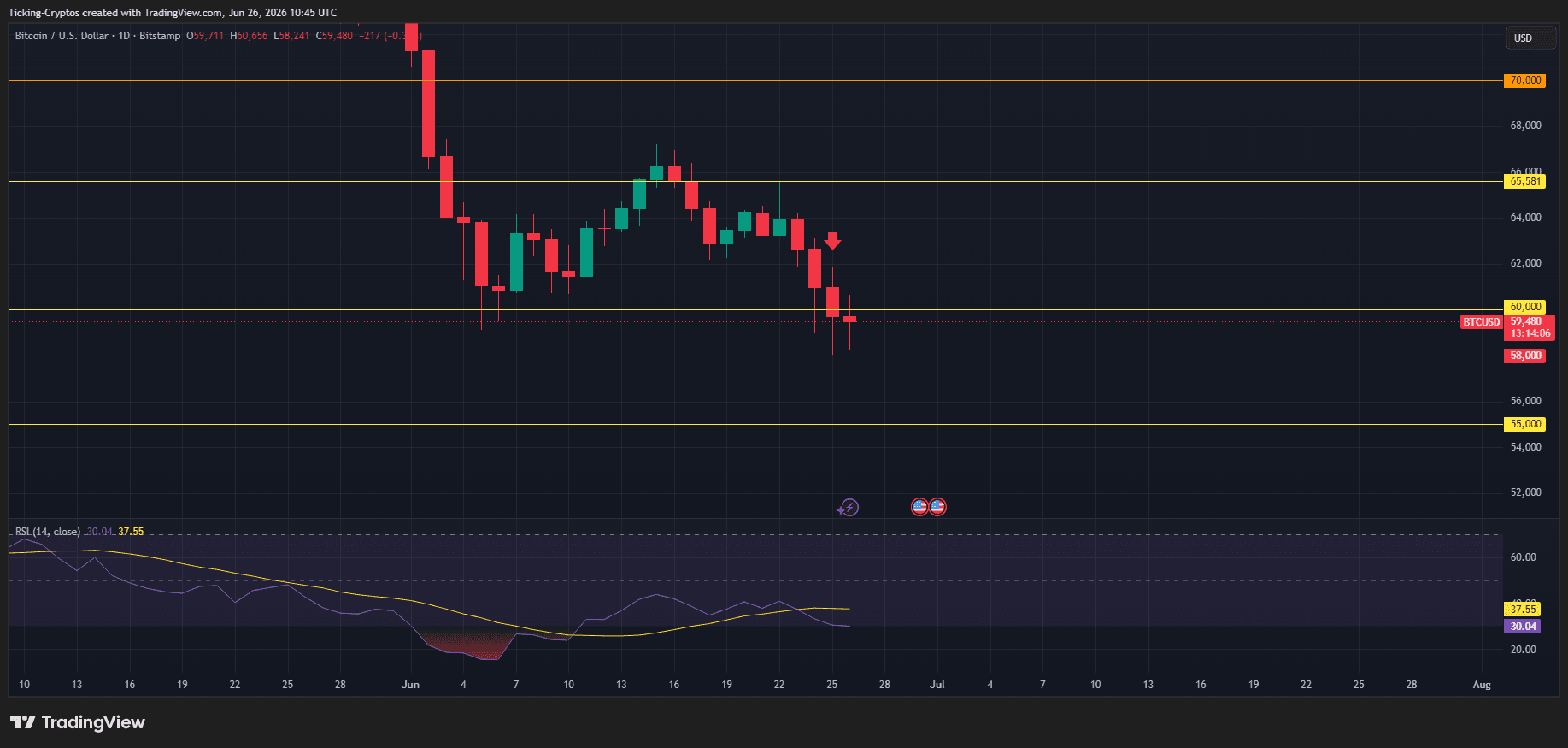
If you’re looking at crypto prices today, brace yourself: it’s a sea of red. Bitcoin ($BTC) is back below the $60,000 mark again, dragging almost the entire market down. After a brutal inflation sell-off, the world’s largest cryptocurrency is trading around $59,586 – and almost all the big money is bleeding alongside it.
Let’s break down exactly where crypto prices stand today, which coins are hitting the hardest, and what caused the recent decline.
What are the current crypto prices?
The damage is big and deep. Here’s where the top of the market is right now:
- Bitcoin ($BTC): ~ $ 59,586 – down 3.39% per day, down 4.35% in 7 days, and a painful 31.91% in the red year to date. The market cap still commands a whopping $1.19T.
- Ethereum ($ETH): ~$1,550 – worst performer, down 5.80% on the day and 47.73% YTD bullish.
- XRP ($XRP): ~ $ 1.03 – down 4.49% for the day and down 8.34% for the week, sticking to the $ 1 line and 43.96% YTD loss.
- BNB ($BNB): ~$565 – the best pick among large caps, down 0.53% on the day.
- Solana ($SOL): ~$69 – down 0.94% hourly but actually up 1.07% over 7 days, a very rare strong fund.
- Dogecoin ($DOGE): ~$0.074 – among the biggest weekly losers, down 9.77% in 7 days.
Two names refer to what is happening. TRON ($TRX) is flat and remains one of the highest in the green year to date, up 13.25%. And Hyperliquid ($HYPE)despite a 5.46% weekly dip, that’s standing across the board with a stunning 148.16% YTD gain – a reminder that even in the hemorrhaging, breakout potential exists.
Why is Bitcoin below $60,000 again?
The trigger this time was big, not crypto-specific. The catalyst was the US Personal Consumption Expenditures (PCE) report, which showed that inflation is heating up more than economists had predicted – and because PCE is the Federal Reserve’s favorite deflationary measure, the surprise shock immediately prompts the Fed to keep interest rates high for a long time.
The numbers were bad. Headline PCE rose to 4.1% year over year in May, the biggest reading since 2023 and more than double the Fed’s target of 2%. The highest prices are kryptonite for risky assets – when government bonds yield 4.5-5%, the capital shifts from speculative games like crypto and becomes safe.
The market immediately went up in price. The shock of inflation led to $1.48 billion in crypto-wide liquidations within 24 hours, with long positions having the biggest impact on $1.21 billion of that figure and Bitcoin alone seeing $665 million in forced outflows. On the negative side, the drop was big – Bitcoin posted a 21-month low of $58,115 during the session before starting to recover a bit.
What else is dragging crypto prices down?
Low inflation was the trigger, but several forces are adding to the damage at the same time.
First, the Fed’s thinking has changed. Markets have pushed back the odds of a December hike to around 77%, with Bank of America now expecting three rate hikes in 2026 and Deutsche Bank predicting two hikes starting in September. The market has gone from price to price transportation – negative crypto evolution.
Second, AI trading continues to steal crypto capital. AI stocks continue to pull speculative money away from crypto, and the Nasdaq 100 ended the day’s rally on the same bullish note. storyand the two markets follow each other closely throughout the year.
Third, there are great options that can be discontinued these days. The largest quarterly settlement in 2026 is the removal of Deribit, with $ 10.6 billion in visible interest, 80% of the positions from the fund, and the main pain of sitting at $ 72,000 – about $ 12,000 more than the current price. The market was set at record highs that were never reached.
Above all, fear is understandable. The Fear and Greed index is deep in the Extreme Fear, around 20-23.
What are the maximum viewing levels?
With $60,000 to break even, the technical map is more important than ever. The $59,000 level is the market bearer today, and a close below it changes another point to $55,000, with deep breast targets at $52,000 and below still on the table.
On the way back, the cows have work to do. The first resistance band is at $61,800-$62,000, while the $63,000-$64,400 zone – where the 21-day EMA resides – may require sustained buying to break.



